

When do you pay stamp duty in the UK? That’s a common question that many people don’t know the answer to (and frequently stress about). As a legal tax, naturally, it’s something you don’t want to get wrong.
Buying a new build home can throw up even more questions, because your move-in date isn’t set in stone. Plus, the process can suddenly start moving quickly, and you want to be ready when it does.
So, not sure why or how to pay stamp duty? Read this article for the answers you need.

When do you have to pay stamp duty?
In England or Northern Ireland, you have 14 days from the ‘effective date’ of purchase to file a Stamp Duty Land Tax return and pay what you owe. This nearly always means completion day, not the day you reserve your plot.
Even if there’s nothing to pay, you still need to file the return. Your solicitor will normally take care of this for you, but legally, the responsibility sits with you. So, be sure to check they’ve handled it.
You won’t need to file a return if:
- No payment was made for the property
- The property was left to you in a will
- The property transfer results from a divorce or civil partnership dissolution
- The price of the property or land is less than £40,000
When does stamp duty need to be paid in Scotland or Wales?
Each has its own version of the stamp duty: Land and Buildings Transaction Tax in Scotland and Land Transaction Tax in Wales. Both have a 30-day deadline. In most cases, your solicitor will collect the tax from you before completion and file the return on your behalf.
When is the stamp duty paid on a new build?
Even on a new build, you’ll pay stamp duty within 14 days of the completion date. Saying that, there are a few things to be aware of since the timing can be less predictable.
Here’s a step-by-step timeline of acquiring a new build, from reservation to completion:
- Reservation. You pay a fee to reserve the plot, which takes it off the market.
- Exchange of contracts. Within roughly 28 days of reserving the plot, you pay a deposit which makes the purchase legally binding.
- Notice to complete. If your home is still under construction when you exchange, the developer notifies your solicitor after signing it off. This is the time to ready your stamp duty funds.
- Completion. Your solicitor includes the SDLT on your completion statement. They need the money in their account before you can pick up the keys.
- The next 14 days. Your solicitor files the stamp duty return for you, and pays HMRC with the funds you transferred in Step 4.
Good to know: If you’re buying off-plan, the applicable stamp duty rates are the ones in place on your completion date, not on the day you reserve.
Wondering when to pay stamp duty if you move in before completion? If you have the chance to move in early, it can bring the 14-day stamp duty deadline forward.
How much stamp duty will you pay?
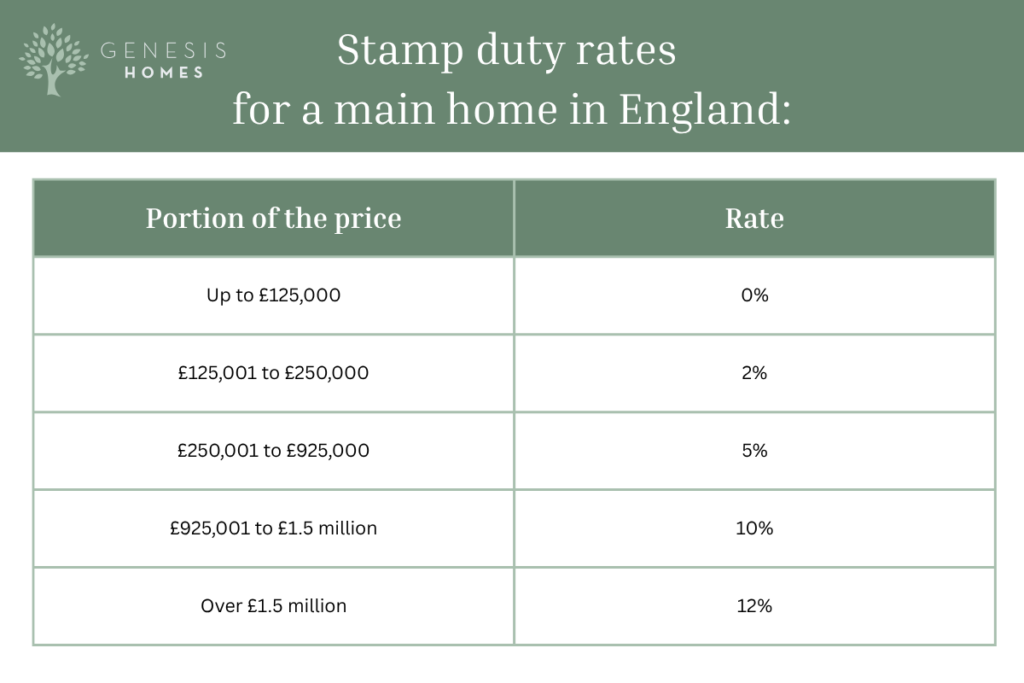
The stamp duty you owe depends on the property price. Each rate applies only to the part of the price that falls within the band.
If you’re a first-time buyer, you pay nothing on the first £300,000. Between £300,001 and £500,000, you’ll pay 5% on that portion. After that, standard rates apply.
A lot of new build homes in Lancashire fall within the third band in the table below (£250,001 to £925,000). To give you an idea, a home-mover buying a property for £250,001 would pay roughly £2,500 in stamp duty while a first-time buyer would pay nothing.
Here are the stamp duty rates for a main home in England:
Recommended reading: Do first time buyers pay stamp duty?
How do you pay stamp duty?
In most cases, your solicitor files the stamp duty return online. You’ll send them the money before you complete, and they pay HMRC. Once HMRC has the return, your solicitor receives the certificate to register you as the owner via HM Land Registry.
How is stamp duty paid if you don’t use a solicitor? If you want to handle it yourself, GOV.UK explains how to pay stamp duty directly.
Side note: If you file the return up to three months late, HMRC charges a £100 penalty, rising to £200 after that, plus interest.
Can you add stamp duty to your mortgage?
Yes, many mortgage lenders let you borrow more money to cover the stamp duty. Though this often increases your monthly payments and means you pay more interest over the life of your mortgage.
Regardless, the money still needs to reach your solicitor before completion. So, the stamp duty cost needs to be part of your mortgage offer from the start, rather than added later on.
We always recommend speaking with a mortgage adviser early to see what works best for you. If you don’t have one yet, get in touch with our friendly team who can help you find one.
How can you avoid paying stamp duty?
The most common way to avoid paying stamp duty is if you’re a first-time buyer spending £300,000 or less. If you’re buying a new build, you can find offers where the developer pays it for you.
Up until the 30th November, we’ll pay your stamp duty up to £15,000* when you reserve a plot at the below developments:
- Olive Green View in Halton, Lancaster
- Lunesdale Rise in Kirkby Lonsdale
To put that in perspective, a home-mover will save £13,750 purchasing a £475,000 home.
Our houses for sale in Kirkby Lonsdale and Halton combine modern layouts, high-quality finishes, breathtaking views, and lots of greenery.
But how does the offer work? HMRC still receives the tax, but we cover it at completion, so it doesn’t come out of your pocket. Your solicitor will let your mortgage provider know about the offer.
*On selected plots only. Terms and conditions apply.
Plan your move with Genesis Homes
You must pay stamp duty within 14 days of your completion date, and your solicitor usually handles it for you. There’s no getting out of paying the tax, unless:
- Your new property is worth less than £125,000
- You’ve inherited the property
- You’re buying your first home for £300,000 or less
If you opt for a new build, you still have to pay tax duty. Right now though, if you reserve a plot on our Olive Green View or Lunesdale Rise developments, we’ll pay it for you.
Ready to take the next step? Explore our new Build Homes in Cumbria & Lancashire.